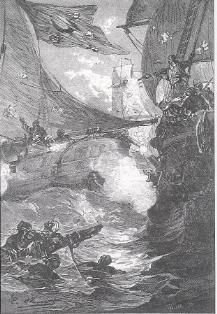
SHIPWRECK DIARIES

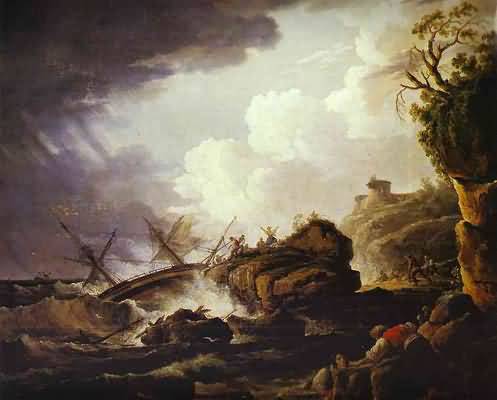
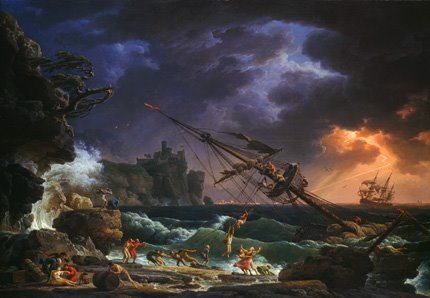
The ship staggered under a thunderous shock
that shook us asunder, as if she had struck and crashed on a rock; for the huge sea smote every soul from the decks of The Falcon but one; all of them, all but the man that was lash'd to the helm had gone."[11. 106-9"]

Tennyson - The Wreck

Saturday, December 16, 2006

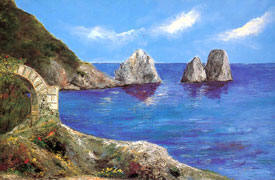
Song of the Sea

Attilio Canale


(Capri, Piccola Marina)

Timeless sea breezes,
sea-wind of the night:
you come for no one;
if someone should wake,
he must be prepared
how to survive you.
Timeless sea breezes,
that for aeons have
blown ancient rocks,
you are purest space
coming from afar...
Oh, how a fruit-bearing
fig tree feels your coming
high up in the moonlight.

Rainer Maria Rilke
Translated by Albert Ernest Flemming

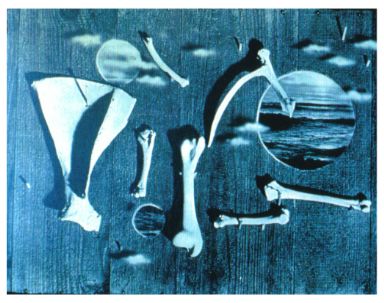
Bones

Herbert Bayer


Sling me under the sea.
Pack me down in the salt and wet.
No farmer’s plow shall touch my bones.
No Hamlet hold my jaws and speak
How jokes are gone and empty is my mouth.
Long, green-eyed scavengers shall pick my eyes,
Purple fish play hide-and-seek,
And I shall be song of thunder,
crash of sea,
Down on the floors of salt and wet.
Sling me … under the sea.

Carl Sandburg

Saturday, December 02, 2006

Sea Longing


A thousand miles beyond this sun-steeped wall
Somewhere the waves creep cool along the sand,
The ebbing tide forsakes the listless land
With the old murmur, long and musical;
The windy waves mount up and curve and fall,
And round the rocks the foam blows up like snow,
-- Tho' I am inland far, I hear and know,
For I was born the sea's eternal thrall.
I would that I were there and over me
The cold insistence of the tide would roll,
Quenching this burning thing men call the soul,
-- Then with the ebbing I should drift and be
Less than the smallest shell along the shoal,
Less than the sea-gulls calling to the sea.

Sara Teasdale

Thursday, November 30, 2006

At Sea


'Farewell and adieu' was the burden prevailing
Long since in the chant of a home-faring crew;
And the heart in us echoes, with laughing or wailing,
Farewell and adieu.

Each year that we live shall we sing it anew,
With a water untravelled before us for sailing
And a water behind us that wrecks may bestrew.

The stars of the past and the beacons are paling,
The heavens and the waters are hoarier of hue:
But the heart in us chants not an all unavailing
Farewell and adieu.

Algernon Charles Swinburne

Sunday, November 05, 2006

Aboard at a ship's helm

ABOARD, at a ship’s helm,
A young steersman, steering with care.

A bell through fog on a sea-coast dolefully ringing,
An ocean-bell-O a warning bell, rock’d by the waves.

O you give good notice indeed, you bell by the sea-reefs ringing,
Ringing, ringing, to warn the ship from its wreck-place.

For, as on the alert, O steersman, you mind the bell’s admonition,
The bows turn,—the freighted ship, tacking, speeds away under her gray sails,
The beautiful and noble ship, with all her precious wealth, speeds away gaily and safe.

But O the ship, the immortal ship! O ship aboard the ship!
O ship of the body—ship of the soul—voyaging, voyaging, voyaging.

Walt Whitman

Friday, November 03, 2006

Wings

http://pedraapedra.weblog.com.pt/arquivo/1060851141_angel_sea2.jpg

"Between the past and the present was an ineffable abyss. But imagination has the wings of an angel of light and travels safely through or over the seas where we have been almost shipwrecked, the darkness in which our illusions are lost, the precipice whence our happiness has been hurled and swallowed up."

Alexandre DumasTwenty Years After

Tuesday, October 17, 2006

Blue


JOHANA
Then, tell me a story.
JACQUES
Uh... Ah! A story? He turns around and sits on the window sill, his feetdangling in mid air. He looks at the sea, seeking inspiration.
JACQUES
Do you know how it is? (starting again) Do you know what you're supposed to do to meet a mermaid?
JOHANA
(with a smile) No... tell me.
JACQUES
You go down to the bottom of the sea, where the water isn't even blue anymore, where the sky is only a memory... and you float there, quietly, quietly and stay there... and you decide that you will die for them... Only then do they start coming out. They come and greet you and they judge the love you have for them... If it's sincere. If it's pure... They will be with you and take you away forever.

Luc Besson

Monday, October 16, 2006

The Sea


"There is, one knows not what sweet mystery about this sea, whose gently awful stirrings seem to speak of some hidden soul beneath; like those fabled undulations of the Ephesian sod over the buried Evangelist St. John. And meet it is, that over these sea-pastures, wide-rolling watery prairies and Potter's Fields of all four continents, the waves should rise and fall, and ebb and flow unceasingly; for here, millions of mixed shades and shadows, drowned dreams, somnambulisms, reveries; all that we call lives and souls, lie dreaming, dreaming, still; tossing like slumberers in their beds; the ever-rolling waves but made so by their restlessness."

Herman Melville
Moby Dick --Chapter 111 (The Pacific)

Sirens


Bronze by gold, Miss Douce's head by Miss Kennedy's head, over the crossblind of the Ormond bar heard the viceregal hoofs go by, ringing steel. -- Is that her? asked Miss Kennedy.
Miss Douce said yes, sitting with his ex, pearl grey and eau de Nil.
-- Exquisite contrast, Miss Kennedy said.
When all agog Miss Douce said eagerly:
-- Look at the fellow in the tall silk.
-- Who? Where? gold asked more eagerly.
-- In the second carriage, Miss Douce's wet lips said, laughing in the sun. He's looking. Mind till I see.
She darted, bronze, to the backmost corner, flattening her face against the pane in a halo of hurried breath.
Her wet lips tittered:
-- He's killed looking back.
She laughed:
-- O wept! Aren't men frightful idiots?
With sadness.
Miss Kennedy sauntered sadly from bright light, twining a loose hair behind an ear. Sauntering sadly, gold no more, she twisted twined a hair. Sadly she twined in sauntering gold hair behind a curving ear.
-- It's them has the fine times, sadly then she said.

James Joyce- Ulysses, Ch. 11-

Friday, October 13, 2006

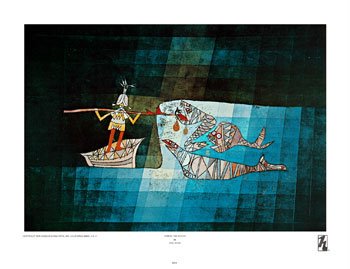
Sinbad by Paul Klee

Becalmed at sea


Deepest silence rules the waters,
Not a motion stirs the sea,
And the sailor views the glassy
Surface so uneasily.
Not a breeze from any quarter,
Dreadful silence, still as death.
In the vast, appalling distance
Not a ripple shows itself.

Goethe

http://members.aol.com/abelard2/goethe.htm

Wednesday, October 04, 2006

The Silence of the Sirens

Proof that inadequate, even childish measures, may serve to rescue one from peril.

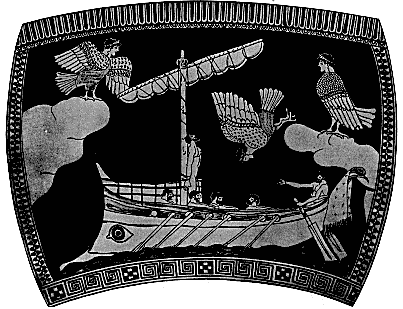
To protect himself from the Sirens Ulysses stopped his ears with wax and had himself bound to the mast of his ship. Naturally any and every traveller before him could have done the same, except those whom the Sirens allured even from a great distance; but it was known to all the world that such things were of no help whatever. The song of the Sirens could pierce through everything, and the longing of those they seduced would have broken far stronger bonds than chains and masts. But Ulysses did not think of that, although he had probably heard of it. He trusted absolutely to his handful of wax and his fathom of chain, and in innocent elation over his little stratagem sailed out to meet the Sirens.

Now the Sirens have a still more fatal weapon than their song, namely their silence. And though admittedly such a thing has never happened, still it is conceivable that someone might possibly have escaped from their singing; but from their silence certainly never. Against the feeling of having triumphed over them by one's own strength, and the consequent exaltation that bears down everything before it, no earthly powers could have remained intact.

And when Ulysses approached them the potent songstresses actually did not sing, whether because they thought that this enemy could be vanquished only by their silence, or because of the look of bliss on the face of Ulysses, who was thinking of nothing but his wax and his chains, made them forget their singing.

But Ulysses, if one may so express it, did not hear their silence; he thought they were singing and that he alone did not hear them. For a fleeting moment he saw their throats rising and falling, their breasts lifting, their eyes filled with tears, their lips half-parted, but believed that these were accompaniments to the airs which died unheard around him. Soon, however, all this faded from his sight as he fixed his gaze on the distance, the Sirens literally vanished before his resolution, and at the very moment when they were nearest to him he knew of them no longer.

But they--lovelier than ever--stretched their necks and turned, let their cold hair flutter free in the wind, and forgetting everything clung with their claws to the rocks. They no longer had any desire to allure; all that they wanted was to hold as long as they could the radiance that fell from Ulysses' great eyes.

If the Sirens had possessed consciousness they would have been annihilated at that moment. But they remained as they had been; all that had happened was that Ulysses had escaped them.

A codicil to the foregoing has also been handed down. Ulysses, it is said, was so full of guile, was such a fox, that not even the goddess of fate could pierce his armour. Perhaps he had really noticed, although here the human understanding is beyond its depths, that the Sirens were silent, and opposed the afore-mentioned pretence to them and the gods merely as a sort of shield.

Kafka

From http://www.ac.wwu.edu/~n9648471/kafka/ksilence.html

A Sea Spell

Her lute hangs shadowed in the apple-tree,
While flashing fingers weave the sweet-strung spell
Between its chords; and as the wild notes swell,
The sea-bird for those branches leaves the sea.
But to what sound her listening ear stoops she?
What netherworld gulf-whispers doth she hear,
In answering echoes from what planisphere,
Along the wind, along the estuary?
She sinks into her spell: and when full soon
Her lips move and she soars into her song,
What creatures of the midmost main shall throng
In furrowed self-clouds to the summoning rune,
Till he, the fated mariner, hears her cry,
And up her rock, bare breasted, comes to die?

Dante Gabriel Rossetti

Sunday, September 03, 2006

Storm


Winds blowing in off the stormy sea,
Sea Gulls fighting the elements raw.
A sight to fascinate all that see,
This most fearsome chaos on the sea-shore.
Boats pitching and tossing on each breaking wave,
It seemed there was nothing that they could save.
Storm clouds ruled the Heavens that night,
Fearsome the thunder and lightning bright.
Rains flooding the land at a breathless pace,
Each drop falling into its chaotic place,
A night to remember with dreadful awe,
As the storm swept over the sea-shore.

Shaw

Another perilous sea by Poe

" I looked dizzily, and beheld a wide expanse of ocean, whose waters wore so inky a hue as to bring at once to my mind the Nubian geographer's account of the Mare Tenebrarum. A panorama more deplorably desolate no human imagination can conceive. To the right and left, as far as the eye could reach, there lay outstretched, like ramparts of the world, lines of horridly black and beetling cliff, whose character of gloom was but the more forcibly illustrated by the surf which reared high up against it its white and ghastly crest, howling and shrieking for ever. Just opposite the promontory upon whose apex we were placed, and at a distance of some five or six miles out at sea, there was visible a small, bleak-looking island; or, more properly, its position was discernible through the wilderness of surge in which it was enveloped. About two miles nearer the land, arose another of smaller size, hideously craggy and barren, and encompassed at various intervals by a cluster of dark rocks. The appearance of the ocean, in the space between the more distant island and the shore, had something very unusual about it. Although, at the time, so strong a gale was blowing landward that a brig in the remote offing lay to under a double-reefed trysail, and constantly plunged her whole hull out of sight, still there was here nothing like a regular swell, but only a short, quick, angry cross dashing of water in every direction --as well in the teeth of the wind as otherwise. Of foam there was little except in the immediate vicinity of the rocks. "The island in the distance," resumed the old man, "is called by the Norwegians Vurrgh. The one midway is Moskoe. That a mile to the northward is Ambaaren. Yonder are Iflesen, Hoeyholm, Kieldholm, Suarven, and Buckholm. Farther off --between Moskoe and Vurrgh --are Otterholm, Flimen, Sandflesen, and Skarholm. These are the true names of the places --but why it has been thought necessary to name them at all, is more than either you or I can understand. Do you hear any thing? Do you see any change in the water?" We had now been about ten minutes upon the top of Helseggen, to which we had ascended from the interior of Lofoden, so that we had caught no glimpse of the sea until it had burst upon us from the summit. As the old man spoke, I became aware of a loud and gradually increasing sound, like the moaning of a vast herd of buffaloes upon an American prairie; and at the same moment I perceived that what seamen term the chopping character of the ocean beneath us, was rapidly changing into a current which set to the eastward. Even while I gazed, this current acquired a monstrous velocity. Each moment added to its speed --to its headlong impetuosity. In five minutes the whole sea, as far as Vurrgh, was lashed into ungovernable fury; but it was between Moskoe and the coast that the main uproar held its sway. Here the vast bed of the waters, seamed and scarred into a thousand conflicting channels, burst suddenly into phrensied convulsion --heaving, boiling, hissing --gyrating in gigantic and innumerable vortices, and all whirling and plunging on to the eastward with a rapidity which water never elsewhere assumes except in precipitous descents. In a few minutes more, there came over the scene another radical alteration. The general surface grew somewhat more smooth, and the whirlpools, one by one, disappeared, while prodigious streaks of foam became apparent where none had been seen before. These streaks, at length, spreading out to a great distance, and entering into combination, took unto themselves the gyratory motion of the subsided vortices, and seemed to form the germ of another more vast. Suddenly --very suddenly --this assumed a distinct and definite existence, in a circle of more than half a mile in diameter. The edge of the whirl was represented by a broad belt of gleaming spray; but no particle of this slipped into the mouth of the terrific funnel, whose interior, as far as the eye could fathom it, was a smooth, shining, and jet-black wall of water, inclined to the horizon at an angle of some forty-five degrees, speeding dizzily round and round with a swaying and sweltering motion, and sending forth to the winds an appalling voice, half shriek, half roar, such as not even the mighty cataract of Niagara ever lifts up in its agony to Heaven. The mountain trembled to its very base, and the rock rocked. I threw myself upon my face, and clung to the scant herbage in an excess of nervous agitation. "

Poe, A descent into the Maelstrom

Storms at sea I

"One evening, leaning over the taffrail, I observed a very singular, isolated cloud, to the N.W. It was remarkable, as well for its color, as from its being the first we had seen since our departure from Batavia. I watched it attentively until sunset, when it spread all at once to the eastward and westward, girting in the horizon with a narrow strip of vapor, and looking like a long line of low beach. My notice was soon afterwards attracted by the dusky-red appearance of the moon, and the peculiar character of the sea. The latter was undergoing a rapid change, and the water seemed more than usually transparent. Although I could distinctly see the bottom, yet, heaving the lead, I found the ship in fifteen fathoms. The air now became intolerably hot, and was loaded with spiral exhalations similar to those arising from heat iron. As night came on, every breath of wind died away, an more entire calm it is impossible to conceive. The flame of a candle burned upon the poop without the least perceptible motion, and a long hair, held between the finger and thumb, hung without the possibility of detecting a vibration. However, as the captain said he could perceive no indication of danger, and as we were drifting in bodily to shore, he ordered the sails to be furled, and the anchor let go. No watch was set, and the crew, consisting principally of Malays, stretched themselves deliberately upon deck. I went below --not without a full presentiment of evil. Indeed, every appearance warranted me in apprehending a Simoom. I told the captain my fears; but he paid no attention to what I said, and left me without deigning to give a reply. My uneasiness, however, prevented me from sleeping, and about midnight I went upon deck. --As I placed my foot upon the upper step of the companion-ladder, I was startled by a loud, humming noise, like that occasioned by the rapid revolution of a mill-wheel, and before I could ascertain its meaning, I found the ship quivering to its centre. In the next instant, a wilderness of foam hurled us upon our beam-ends, and, rushing over us fore and aft, swept the entire decks from stem to stern. The extreme fury of the blast proved, in a great measure, the salvation of the ship. Although completely water-logged, yet, as her masts had gone by the board, she rose, after a minute, heavily from the sea, and, staggering awhile beneath the immense pressure of the tempest, finally righted. By what miracle I escaped destruction, it is impossible to say. Stunned by the shock of the water, I found myself, upon recovery, jammed in between the stern-post and rudder. With great difficulty I gained my feet, and looking dizzily around, was, at first, struck with the idea of our being among breakers; so terrific, beyond the wildest imagination, was the whirlpool of mountainous and foaming ocean within which we were engulfed. After a while, I heard the voice of an old Swede, who had shipped with us at the moment of our leaving port. I hallooed to him with all my strength, and presently he came reeling aft. We soon discovered that we were the sole survivors of the accident. All on deck, with the exception of ourselves, had been swept overboard; --the captain and mates must have perished as they slept, for the cabins were deluged with water. Without assistance, we could expect to do little for the security of the ship, and our exertions were at first paralyzed by the momentary expectation of going down. Our cable had, of course, parted like pack-thread, at the first breath of the hurricane, or we should have been instantaneously overwhelmed."

Poe, Ms. in a Bottle

Sunday, August 13, 2006

Merry gentlemen of the sea...


We were schooner-rigged and rakish, with a long and lissome hull,
And we flew the pretty colours of the crossbones and the skull;
We'd a big black Jolly Roger flapping grimly at the fore,
And we sailed the Spanish Water in the happy days of yore.

We'd a long brass gun amidships, like a well-conducted ship,
We had each a brace of pistols and a cutlass at the hip;
It's a point which tells against us, and a fact to be deplored,
But we chased the goodly merchant-men and laid their ships aboard.
Then the dead men fouled the scuppers and the wounded filled the chains,
And the paint-work all was spatter dashed with other peoples brains,

She was boarded, she was looted, she was scuttled till she sank.
And the pale survivors left us by the medium of the plank.
O! then it was (while standing by the taffrail on the poop)
We could hear the drowning folk lament the absent chicken coop;
Then, having washed the blood away, we'd little else to do
Than to dance a quiet hornpipe as the old salts taught us to.

O! the fiddle on the fo'c'sle, and the slapping naked soles,
And the genial "Down the middle, Jake, and curtsey when she rolls!"
With the silver seas around us and the pale moon overhead,
And the look-out not a-looking and his pipe-bowl glowing red.
Ah! the pig-tailed, quidding pirates and the pretty pranks we played,
All have since been put a stop to by the naughty Board of Trade;
The schooners and the merry crews are laid away to rest,
A little south the sunset in the islands of the Blest.

A Ballad of John Silver, by John Masefield